
Ghost Weddings: Marrying the Dead
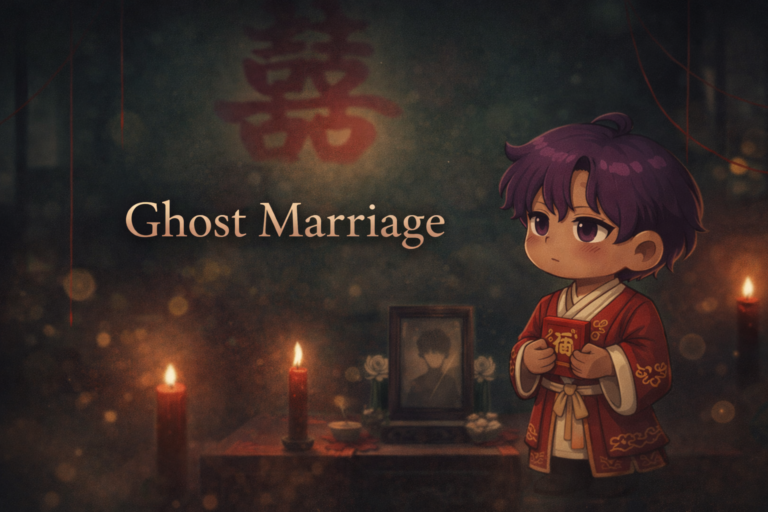
Imagine being inside a room that feels too quiet. No laughter, no music, no sound of celebration. Only the slow burning of incense, filling the air with a scent that feels heavier the longer you stay. In the center of the room, two figures sit side by side, dressed in red wedding clothes, carefully arranged, perfectly prepared.
From a distance, it almost looks like a normal wedding.
But the closer you look, the more something begins to feel wrong.
They are not moving. They are not breathing.
And yet, the ceremony continues as if nothing is unusual.
People stand around them calmly. No one questions it. No one reacts. Rituals are being performed, words are being spoken, offerings are being placed in front of them. It looks like a union, but it feels like something else entirely.
Because this is not a marriage between two living people.
This is a ghost marriage.
What Lies Behind This Ritual
Chinese ghost weddings, often known as Minghun or sometimes referred to as yin hun, are not myths or stories created to scare people. They are real rituals that have existed for years.
In some parts of China, families arrange marriages for those who have died unmarried. Sometimes one person is alive and the other is dead, but in many cases, both are no longer living. This form of ghost marriage is also seen in regions like Taiwan and parts of Southeast Asia, where similar beliefs about the afterlife exist.
The belief behind this is simple, yet deeply unsettling.
A person who dies without marriage is believed to become restless. Their spirit does not settle. It wanders, incomplete, carrying a kind of silence that never feels at peace.
And a restless spirit is not something families are willing to accept.
So they give them what they never had.
A partner.
A marriage.
A place to belong, even if it comes after death.
When Death Does Not End Expectations
At first, it sounds like something rooted in care, almost like an attempt to protect the one who has passed away.
But the more you think about it, the more disturbing it becomes.
Because a ghost marriage does not end expectations. It does not free you. It only changes the form in which control continues.
Even after everything is over, something is still being decided for you.
The Ceremony That Continues
The ceremony itself is not symbolic in the way most people imagine. It is detailed, structured, and taken seriously, almost like a traditional hunli that never truly belongs to the living.
In some cases, families use photographs or personal belongings to represent the deceased. Paper figures are created and burned as offerings, meant to carry meaning into the afterlife.
But in other cases, something more real is used.
The bodies themselves.
The deceased are dressed in wedding clothes, placed carefully beside each other. Their faces are sometimes covered, sometimes left visible. Cold, still, untouched by the moment that is supposed to define a new beginning.
Incense is lit. Prayers are spoken. Rituals unfold exactly as they would in a normal wedding.
And yet, there is no response.
Only silence.
And still, the ghost marriage continues.
The Part No One Talks About
There is another side to this tradition, one that is rarely spoken about but impossible to ignore.
When a family cannot find a suitable partner for the deceased, they begin to search.
And sometimes, that search leads to places that feel darker than the ritual itself.
There have been cases where bodies were stolen from graves, taken not for revenge or crime in the usual sense, but for ghost marriage.
In some places, there have been underground exchanges where dead bodies are sold, treated as something that can complete a ritual rather than something that once held a life.
A body becomes a bride.
A name becomes a role.
A person becomes part of a ceremony they never chose.
The Fear Behind It
That is where the fear begins to shift.
It is no longer about spirits or rituals.
It becomes something more human, and somehow, that makes it worse.
The fear of loneliness is so strong that people try to escape it even after death. The idea that being alone is more terrifying than being bound to something unknown, something silent, something permanent.
That is what a ghost marriage quietly reflects.
It raises a question that stays with you longer than the story itself.
If someone can decide your life, shape your path, and define who you are while you are alive, and then decide your death, your rituals, and even who you spend eternity with, where does your choice ever exist?
The Silence After Everything Ends
Imagine the final moment.
The ceremony is over. The room is empty. The incense has burned down to ash. The voices are gone. Everything becomes quiet again.
Beneath the ground, two figures lie side by side, dressed for a wedding that has already passed, connected by something they never agreed to.
A ghost marriage that does not end.
Resting in a silence that feels heavier than before.
And somewhere in that silence, there is a thought that is difficult to ignore.
What if something is still aware?
What if something is still waiting?
A Thought That Stays With You
Ghost marriages are often explained as tradition, as culture, as belief.
But if you look closely, they are something else entirely.
They are a reflection of fear that does not end with life. The fear of being alone. The fear of being forgotten. The fear that even death might not give you peace.
And maybe that is what makes it truly unsettling.
Not the idea of spirits. Not the rituals. Not even the silence that follows.
But the possibility that even after everything ends…
Something still expects you to belong.
And whether you want to or not…
The ceremony continues.